
Enjoy your new rabbit hole


The library floors are busy in the quiet way only libraries can be. Each one is arranged for grazing, scanning, comparing, or, for the deepest focus, sinking. The librarian glances at her booking.
- Still on adaptive environments?
- Unfortunately, yes.
- Is this a personal rabbit hole or a one for work?
- Both. So, professional, unfortunately.
The librarian nods and slides the assessment slate across the desk. A lifelong learning seal appears in the corner, beside the consent notice.
- Same format as last time? Four-week rabbit hole, guided skim, focused evenings and four field sessions? We still have Thursday non-adaptive slots.
- Three field sessions, please. It’s a quarter close.
- That’s what everyone says before choosing the twelve-book path.
- I am not choosing the twelve-book path.
- Good. The system has already rejected you for it.
She turns surprised, and a little offended.
- It rejected me?
- Your skim history rejected you. Guided skim only works if you move fast enough for the learning assistant to map where your attention comes alive. You keep trying to finish everything.
- And that’s a bad thing?
- For a rabbit hole? Terrible. Exploratory learning needs loose ends.
She sighs when the slate lights up.
[Desired outcome]
She presses the form and hesitates for a moment.
- I want to understand how to stay open in a world that keeps adapting to what I already like.
The librarian reads it and makes the small face librarians make when they like something but refuse to reward it too much.
- Nice. A little dramatic, but usable.
- Thank you?
- Well, you’re not here to finish books but to build the attention the subject requires. If you only wanted the useful parts, you’d use a course generator. You’re obviously here to turn information into lived understanding. Comfort, contradiction, or velocity?
- Contradiction.
- Amount?
- Medium.
The librarian taps the counter twice.
- Medium contradiction is for people who want to feel brave and still sleep. The system thinks you’re ready for the sensors and architecture track. I disagree. You’re still trying to win the argument. Let’s give you someone who changed their mind first.
- Fine. I’ll take high.
- High requires one book you’ll dislike.
- One?
- One minimum.
The slate updates.
[Disliked book required]
She approves the usual temporary access and the librarian opens her attention profile. A thin map of habits appears between them: where she slows down, where she skips, where she rereads the first paragraph three times, and where she bookmarks and never returns.
- You’re still over-collecting.
- I prefer to call it preparing.
- You saved ninety-three pieces on adaptive systems this month.
- That sounds prepared.
- You opened six.
- That sounds busy.
- And finished one.
- That’s unfairly specific.
The librarian removes two books from the recommended path before she can see them.
- Hey.
- They were flattering you.
- I like being flattered by books.
- I know. That’s why I removed them.
The path settles into sections: five books, an essay bundle, a disagreement checklist, a deck of conversation cards, and a few focused walks. She points at the walks.
- Are those required?
- Only if you want lived understanding.
- I thought that was the whole point.
- It is, but people still like being asked so they can disagree accurately.
- Okay, and what’s usually in the walk?
- Two hours in a non-adaptive district. City defaults. No preference layer, no mood lighting, no assistant suggestions.
- So… just walking outside?
- Outside used to be less configured.
She studies her plan.
- And what am I supposed to be looking for?
- Depends on the week. The first thing you miss. The first thing that annoys you. The first stranger your environment would usually remove from your path.
- Getting mildly lost? That’s annoyingly good.
The slate asks for intensity.
[Skim / Read / Argue / Practice]
She selects all four. The librarian looks at her booking, then removes one before the slate can encourage her.
- I thought you had only three field sessions?
[Phase 1: Why being understood feels good]
[Phase 2: What does preference optimisation remove]
[Phase 3: How to keep surprise in the loop]
A small warning appears underneath.
[Potential side effect: reduced tolerance for personalised convenience.]
She looks up, interested.
- Is that a real warning?
- Since last year. We had complaints.
- From readers?
- Mostly from their smart homes. Some count disengagement as negative feedback.
She smiles, and the librarian prints the receipt. Actual paper. Cream-coloured. A little theatrical, but this is why people still come in. At the bottom, under the return window and the field session code, the library’s usual sign-off waits.
- Enjoy your new rabbit hole.
She folds it into her coat.
- Thank you. How will I know it’s working?
The librarian brings up the next appointment on the counter and does not look up.
- You’ll turn off something that knows you too well and feel weirdly proud of yourself. Next please.

Memories to build from this future
Think about a day when everything was exactly how you like it. The coffee the way you always have it, a route you could walk with your eyes closed, the lunch you order without reading the menu. It was easy, pleasant, and entirely unsurprising. Underneath it sat a small wish, so quiet you almost missed it, that one thing would catch you off guard.
Now, stay with that wish for what you would never have picked:
1. Think back to a regular evening when you switched off the preference layer that tuned your surroundings to your established tastes.
What was the first thing you noticed once nothing around you was being curated for you?
Which person or idea that your usual sorting would have skipped actually caught your attention?
How did it feel to move through a space that made no effort to anticipate you?
2. Go back to a stretch of work when your team dialled up contradiction on purpose, choosing voices and ideas built to push back instead of flatter.
How did the room change once people came to the meeting ready to be challenged?
Which belief did you change after spending real time with a view you disagreed with?
What became easier to say once friction was the plan and not an accident?
3. Try to recall the year your organisation built a real appetite for ideas its usual sources would never have surfaced.
What unfamiliar voice, signal, or example reached a decision it would once have missed?
Which unexpected idea changed how people understood the problem?
How did seeking out the unfamiliar become a normal habit, not a special exercise?
Before we finish here.
If the world kept getting better at giving you more of what you already liked, what would you seek out on purpose to stay open?
What small step would you be curious to try first? And does anything from this one tie back to patterns you’ve noticed across other sessions?
Each memory from the future you build sharpens your strategic instincts for the decisions ahead.
Build enough memories.
Shape better futures.
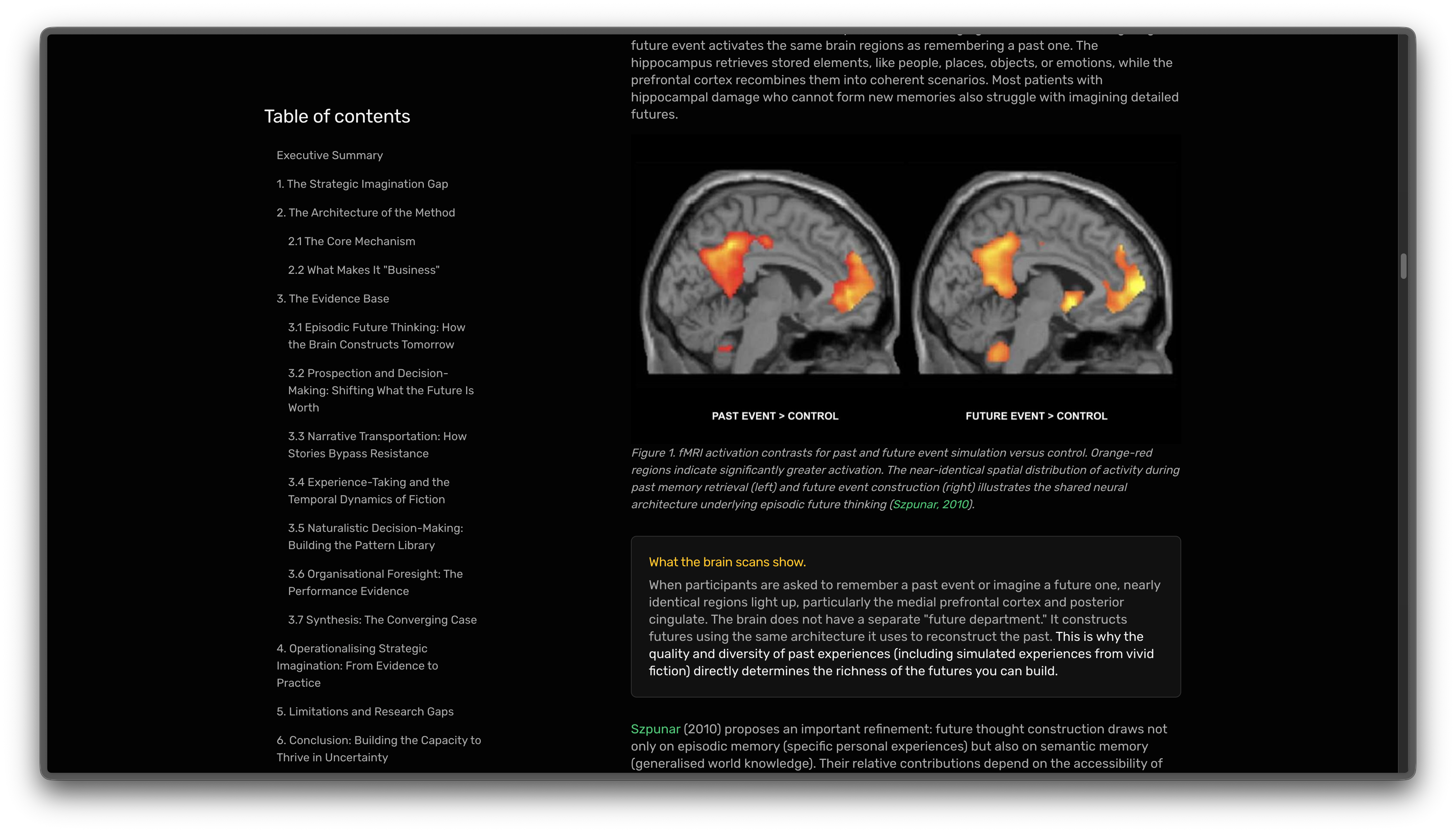
The science behind rehearsing the future.
How science fiction trains your brain to thrive in a world that refuses to be predictable.
Know someone who could use more strategic imagination?
Share Practical Futures with your network.