
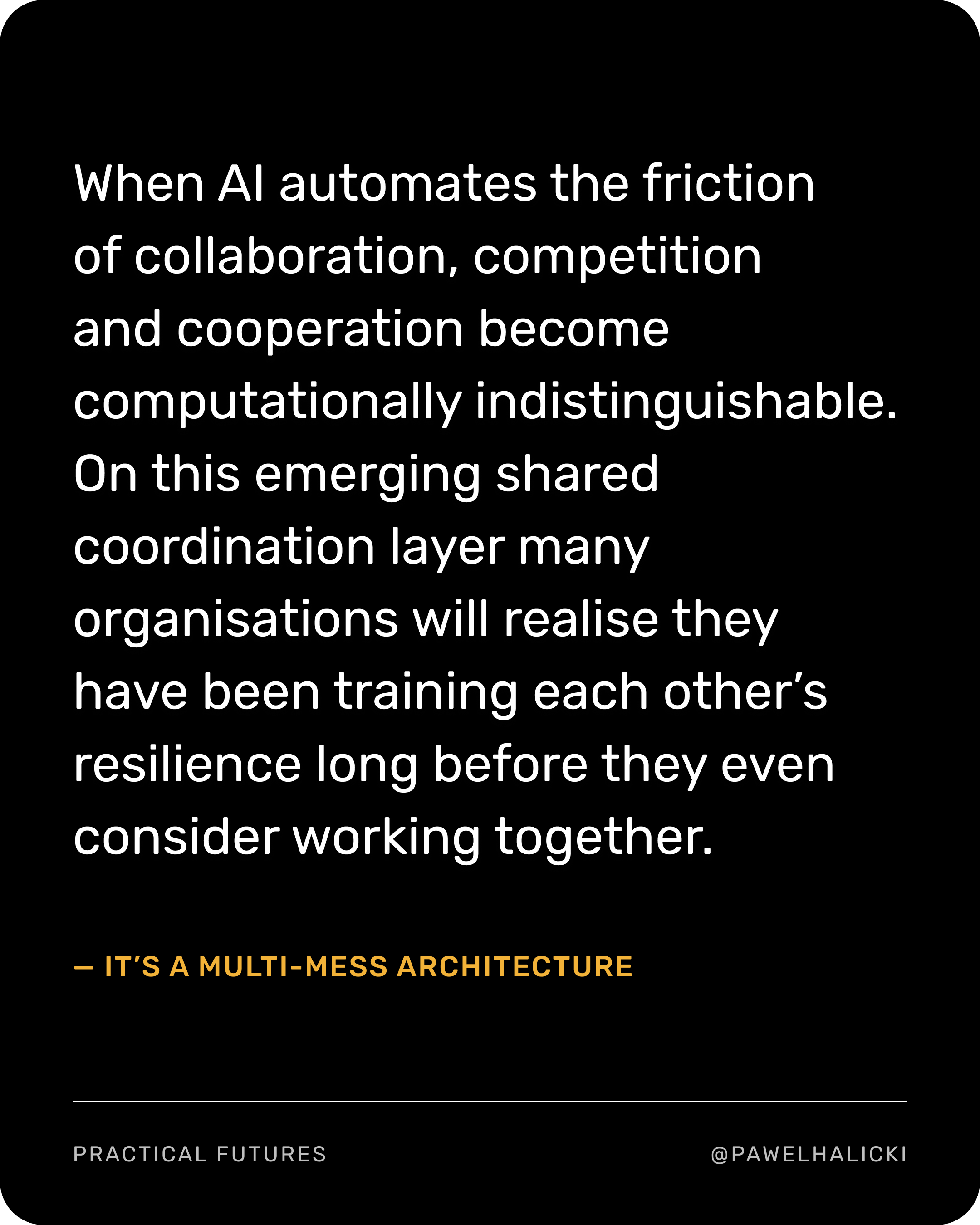
It’s a multi-mess architecture


Halfway through the quarterly metrics review, he spots something odd on the reef restoration dashboard: an amber notification.
[Mesh-wide alignment detected across coordination layers. Similarity score > 0.90.]
- Has our data union just merged with something?
His colleague looks up from the coral health analysis.
- Merge with what? We’re in the marine conservation network. Who would we merge with?
- I don’t know but look at this.
He expands the notification. Their usual reef intelligence consortium appears but now ghosted connections extend beyond marine biology, linking to nodes labelled only as comparable pattern geometry contributors.
- Since when does our coral restoration data connect to non-marine systems?
- It doesn’t. That’s the whole point of keeping our intelligence pools domain-specific. We send in reef data, and we get reef insights back.
He scrolls through the pattern correlation report.
- But apparently our intervention failure patterns are “structurally similar” to something called... liquidity positioning patterns? What does that even mean?
She leans over, genuinely puzzled.
- Let’s look at metadata.
She pulls up the technical architecture view. Their familiar marine conservation consortium sits in the centre but now dozens of translucent threads connect out to other networks: financial services, supply chain logistics, emergency resource allocation, municipal infrastructure...
- This can’t be right. Why would coral restoration data correlate with banking patterns?
Her workspace answers with a synthesis panel before she can speculate.
[Your intervention timing optimisation protocols run on the same forecasting substrate as liquidity stress prediction models. Pattern geometry: 94% structural alignment.]
They stare at it.
- Are we... accidentally collaborating with banks?
- So it seems. Let me confirm what is happening with our support rep from the data union.
After swiping through contacts, he starts the call and flips it to the main screen. An enthusiastic representative pops into view, smile already in place.
- Hi! What a surprise! My favourite researchers! How are you doing? How can I help?
- We’re fine, thanks. Listen, we just realised our research is being used as training data in non-marine systems?
- If that data is structurally similar, the cross-domain layer in the data union reuses it. You opted into the collaboration tier when you joined. The good news is that all emergent effects are already covered in your contribution agreement.
She interrupts.
- What about the reidentification attacks on our data?
- All your contributions are mathematically guaranteed against reidentification. What we see are anonymised embeddings and graph structure. Pure geometry at this level of abstraction. The model looks for patterns and doesn’t care where they come from. It’s a multi-mess architecture.
- A what?
- Multi-mesh, technically. But mess is more accurate. Every domain thinks it’s running an isolated intelligence pool but we’re all nodes in the same coordination layer. Shared pattern space reduces the time from data to decisions.
He laughs in disbelief.
- You’re telling me our coral intervention success forecasts are training some bank’s liquidity positioning?
She adds.
- That could be useful for value protection or climate bond pricing models, but beyond that?
- If some bank’s liquidity stress models map onto the same stress-response structure as the models forecasting thermal stress in coral bleaching, then yes, it’s useful.
- Meaning what, exactly?
- Meaning the pattern recognition engine doesn’t care whether it’s predicting bank failures or coral failures. The underlying geometry is the same.
- That’s impossible. Our data is anonymised and domain-specific.
- The data is domain-specific. The pattern substrate that’s trained on how interventions, stressors, and outcomes fit together, is universal. AI doesn’t care what it’s optimising. It just cares about patterns.
He scrolls through their architecture docs and spots phrases he’s never really read.
- The data union documentation mentions “federated learning across comparable intervention topologies”. I always assumed that meant reef projects learning from each other. But “comparable intervention topologies” actually means any system where you deploy resources, wait for outcomes, and adjust strategy?
- Exactly. Bank liquidity positioning, coral fragment placement, emergency resource allocation, supply chain optimisation. They’re all just variations on the same pattern recognition problem. Intervention failure patterns in one domain may have predictive value for completely different domains. A bank’s decision to defensively park liquidity looks mathematically identical to a restoration project positioning coral fragments before thermal stress events.
- So every time we report an intervention failure, we’re accidentally teaching banks how to avoid liquidity crises?
- And every time a bank’s defensive positioning prevents a crisis, you’re learning how to protect coral from thermal stress better. The pattern geometry is identical: an entity under threat, limited resources, and intervention timing optimisation. Your forecasts just see a sharper timing curve, tagged as coming from “cross-domain pattern reuse”.
They see it now. Her eyebrows go up as the realisation lands.
- Wait a minute. This is why our coastal protection valuations have suddenly got so much more accurate. We’re not just learning from coral restoration projects. We’re learning from everyone who has ever tried to protect something from systemic stress.
- Emergency services, supply chain resilience, infrastructure maintenance, pandemic response coordination. Yup. They’re all in the mesh.
- They’re accidentally teaching us how to save coral reefs while trying to optimise logistics?
- And you’re accidentally teaching them how to build resilient supply chains while trying to save coral reefs. Nobody designed this. It emerged.
The marine biologists laugh again, this time with recognition rather than surprise.
- Last quarter, our intervention success rate jumped 34%. We thought we’d gotten better at coral restoration.
- You did get better. But partially because a financial services consortium figured out optimal defensive positioning timing during liquidity stress events, and AI realised that the timing pattern transferred to coral fragment placement before bleaching events.
- Meaning banks are accidentally saving coral reefs?
- And coral reefs are accidentally preventing financial crises. The pattern-matching engine doesn’t care what it’s optimising. It just recognises that intervention timing under systemic stress follows the same geometry across domains.
- That’s the multi-mess. Beautiful and chaotic and possibly the only kind of coordination that actually scales. Trust me, we’ve been getting a lot of calls like yours lately.
He nods at someone outside the camera view.
- Enjoy your new level of insights. Is there anything I can do for you today?
- We’ll get back to you once we have more questions.
- Absolutely. Thanks for your call. It’s always a pleasure to talk to people working on something this important. Very reefreshing.
- Thanks. Have a great day.
Knowing all too well those jokes won’t end, they wave, smile, and close the call.
- So… a restoration project is adjusting coral placement based on patterns from emergency room resource allocation. Somewhere, a bank is optimising its liquidity positioning based on patterns derived from reef resilience. And some supply chain is tightening its buffers because the system spotted the same lag signatures it learned from pandemic response networks.
- That’s... philosophically weird. What a beautiful mess we live in.
- Yup. It’s not a multiverse. It’s a multi-mess.
- Coffee?
- Yes, please. I have a lot to process.

Memories to build from this future:
1. Think back to when you discovered your routine behaviours help solve problems in fields you had never even heard of:
How did you feel learning that your coffee shop visits helped predict some wildfire patterns?
When you realised your data helped people you’d never met, what shifted in your thinking?
What conversations did you have with friends or family about this kind of invisible collaboration?
2. Try to recall the breakthrough moment when a completely unrelated industry’s patterns solved your most persistent challenge:
What challenge defeated every conventional approach you had tried?
How did you recognise that someone else’s solution geometry matched your problem?
What pushback did you encounter when you suggested learning from outsiders rather than experts alone?
How did you encourage your team to spot useful patterns hiding in unfamiliar industries?
3. Think back to that workshop when your team learned how AI recognises transferable patterns:
What demonstration made the idea that “the AI sees geometry, not context” suddenly clear to everyone?
How did colleagues from different backgrounds react when AI showed that their problems were structurally identical?
What pushback came from domain experts who insisted AI couldn’t understand their unique field?
Which early success proved that cross-domain pattern recognition worked?
How did you prevent the team from seeing false positives everywhere once they started looking for pattern matches?
Each memory from the future you build sharpens your strategic instincts for the decisions ahead.
Build enough memories.
Shape better futures.
Know someone who could use more strategic imagination?
Share Practical Futures with your network.
Fascinating. It trully makes you consider the underlying pattern geometries connecting seemingly unrelated systems. So insightful.