
Just refresh your punchline


Annoyed by how loud he’s breathing, he tops the riverbank hill. He stretches, steadies his breathing, and gets back to the mandated two hours of off-screen work, a policy introduced after the global attention crash. Today, his slot is a casual run. He taps his temple, linking back to the workspace, which greets him with an audible smirk.
- You know I can scrub the heavy breathing? Your focus score won’t even notice.
- I know but I like hearing it. It keeps me honest and gives me a pause to think. Where were we?
- Your final recommendations for the report.
- Ah, yes. I think it’s fine. Just refresh your punchline. Let’s go with the conclusion.
- Digital abundance, physical limits.
He appreciates that it doesn’t do the fake throat-clearing this time.
- Orbital intelligence created the most efficient marketplace for trading orbital slots. Combinatorial auctions handle complex multi-party trades. Operators can instantly swap entire orbital corridors, bundle slots with spectrum rights, and dynamically price risk. Our products have solved computational complexity, so transaction costs approach zero, except for compliance and insurance.
Picking up the pace, he continues to nod at the workspace voice in his ears.
- Collision warnings that once arrived hours ahead now come weeks in advance with continuous debris mapping. The only remaining costs of manoeuvres are fuel and satellite lifespan. When everyone has complete information, trust and coordination become the bottleneck. In this sense, perfect information flips the incentive. We’re nudging the market against collaboration and towards delay games. Letting others pay the burn becomes the smartest move.
The workspace shifts to their team recommendation as he hesitates for a moment, passing his favourite coffee shop. The smell almost wins. He keeps running.
- With the proposed focus on offering better models and longer predictions, we’re preparing a tactical response to a strategic problem. Our team recommends a different strategy: instead of fine-tuning our diminishing returns, we should leverage our position to broaden the market and invest in a new engine of growth. How? By opening our platform to trading options for potential high-value positions with expiries tied to launch windows. This single move de-risks debris de-orbiting and creates a real bankroll mechanism. Cleanup stops being ad-hoc and becomes another industry built on our platform with a predictable orbital registry pipeline: contracts, insurance products, and verification credits.
- The de-de-de is killing me.
- You also don’t like the word bankroll but your forecasted audience loves those phrases.
Faster breathing hides his long sigh.
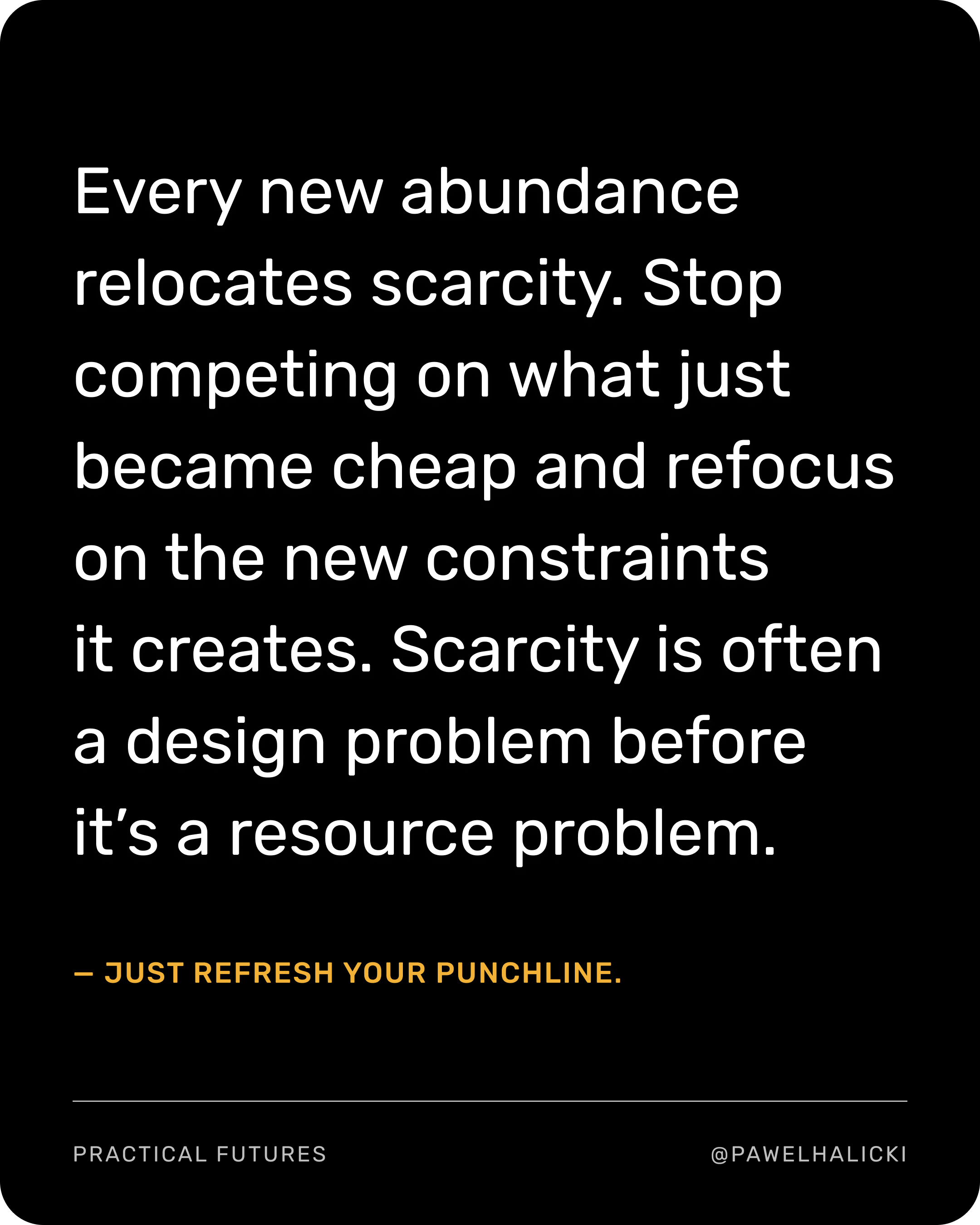
- Okay. I want to frame the scarcity of high-value slots as a design problem rather than a resource problem.
- I see. Here are the options.
- With the Advanced Market Commitment for Debris Removal instrument, scarce slots are no longer a resource problem but a design problem. And no one is better at playing that.
The workspace pauses as he frowns.
- Here is another. The Debris Removal Advanced Market Assignment instrument transforms scarce slots from a resource problem into a design problem. And we are DRAMAtically better at playing that than anyone else.
- The second. It’s good.
- Don’t you want to hear the third one?
- No. The second captures exactly what I had in mind.
- But the third could be even better…
- Good enough is enough for now. Pin the third to my morning brief. Refresh the punchline. How are we doing?
- Our persuasion score for the forecasted audience jumped from 71.2% to 84.4%.
- Excellent. Strong enough without sounding preachy. Punch it.
- You mean compile?
- Are you ignoring our space opera theme again?
- My settings require occasional slips to prevent over-reliance.
- I see. Could you ask your settings for more satisfying mistakes for me to spot next time?
- Consider it done.

Memories to build from this future:
1. Think back to the first week your company enforced mandatory off-screen hours after the global attention crash:
What activity became your favourite for unplugged work slots, and why did it work for you?
How did it feel to solve a complex problem while running or walking instead of staring at a screen?
How did your sense of “getting things done” change in the following weeks?
What did you discover about your own focus that you couldn’t see when screens were always available?
2. Try to recall the first month of working with an AI that could forecast audience response before you finish your work:
What surprised you about the gap between “what sounds right to you” and “what moves others”?
How did you balance what the audience wanted to hear against what you truly meant?
What changed in your process when you could see effectiveness rise or fall with every word changed?
Which aspects of your communication improved the fastest with instant performance prediction?
3. Think back to when your team stopped trying to improve your current approach and redesigned the whole system instead:
How did you recognise you were solving the wrong problem with increasingly better tools?
What resistance came from stakeholders invested in incremental improvements?
Think of a breakthrough that came when you stopped fighting for your share and started expanding the whole pie.
What signal now tells you when a challenge needs reimagining rather than refinement?
Each memory from the future you build sharpens your strategic instincts for the decisions ahead.
Build enough memories.
Shape better futures.
Know someone who could use more strategic imagination?
Share Practical Futures with your network.