
You’re a great problem swarmer


The viewing room smells of coffee and dry-erase markers. Behind the mirror, the next subject is already halfway through the test when the door opens. Their director steps in, scans the faces around the table, and tries to read the answer before anyone says anything.
- Sorry for joining late. How are we doing?
The researcher methodically lays out the performance charts.
- So far, so good. Earlier groups got stuck when we tried to explain how changes in wireless signals reveal motion and presence without using cameras. This time, we stopped explaining and let people use the demo frames to see what our paints and coatings make possible.
- So you’re making them try the WiFi vision overlay first? Makes sense. And you didn’t panic even once.
- I only panic internally. Once the demo shows them what our products can do, the whole thing clicks. Paint that blocks signals. Coatings that highlight movement. Walls that tell one’s home where it is allowed to sense and where it has to go blind.
The materials engineer leans in, flicking a list of participant ideas onto the shared display.
- They even invent use cases once they understand what’s possible.
- Yeah. One participant asked if you could layer signal-blocking and highlighting paints to make WiFi graffiti.
- WiFi-reactive pigments in art supplies? Interesting. And a moderation nightmare.
- You simply watch too many risk briefings.
The director relaxes and reaches out for a water bottle but doesn’t open it. Behind the one-way mirror, a woman in a cardigan and reading glasses on her forehead is moving through the tasks with visible satisfaction.
- Home, where’s my inhaler?
Your inhaler is in the cabinet with the plant on top. Second drawer on the left.
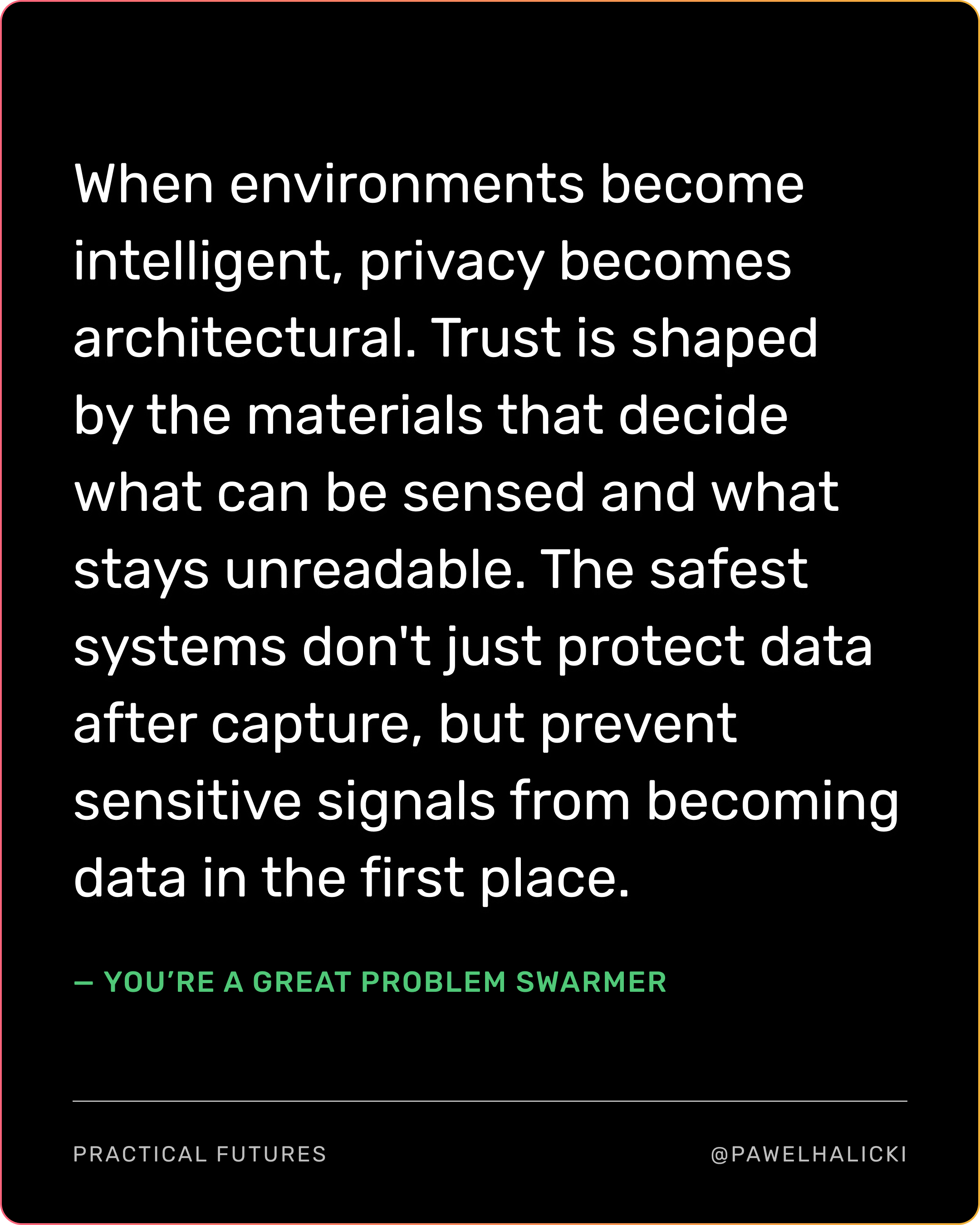
- I’m glad you found the aha moment. Of course you did. You’re a great problem swarmer.
- That must be my favourite compliment.
- Good. It’s also a job description.
The researcher looks at the mirror for a moment.
- You’re very kind, but I’m just the person who rolled out the reorg.
- It’s still a job. Knowing how to bring the chemistry out of people who are not in the same room together? That’s not in any org chart.
- Actually, it is. Before, we handed problems over to each other. Now the liquid org chart pulls everyone around the same use case, the moment the problem is the easiest to work on.
The materials engineer pulls another chart into the shared display.
- Our outcome model helped, too. Nobody owns the paint itself anymore. They own what you can do with the product.
- Fair point. And how is the privacy update going? It can’t be just another software toggle. Some things need to stay unreadable.
- Progress, with a delay. Construction and ambient interfaces are still testing the layered coating on old concrete. The cracks in the old walls keep scattering the signal.
- Two weeks or more?
- With everything the org chart pulled in for them? Two days, tops. The secure pigment batch is already cleared and logged. They’ve got enough to finish testing the old walls.
Behind the glass, the moderator thanks the subject. The woman in the cardigan leaves smiling.
- Good progress. Let me see that privacy testing with my own eyes.
- They’re in the wet room, second floor.
The director taps the side of her frames once, already halfway to the door.
- Tell me something I don’t know.

Memories to build from this future
Think about the last time you used something that fit you before you had thought to adjust it. A kitchen where everything was already within reach. A path through a building that took you exactly where you needed to go. Nothing about it felt complicated. It met you where you already were.
Now, stay with that ease:
1. Try to recall a morning you asked your home where your favourite shirt, the keys or the kid’s bag were, and the answer came back without a single camera in the house.
What kinds of help did you start asking for from your home once it could read what was happening without needing to see it?
Which device or service did your household stop saying no to once it didn’t come with a camera attached?
How did conversations about household chores change once your home could quietly read what had been done?
2. Think back to the week the org chart pulled you into a problem nobody on your team would have touched.
What changed about how you contributed once you arrived at a problem from outside the usual line-up?
How did chemistry form with people you had never worked with before and might never share a room with again?
When did being pulled in from outside stop feeling unusual?
3. Go back to a regular day a year after your organisation stopped measuring what it delivered and started measuring what people did with it.
What changed about how teams talked about success once nobody could point to their own piece of work?
How did career conversations evolve once people moved with the use case instead of staying inside one lane?
Where did you first notice that an old rivalry between teams had quietly dissolved because both sides shared the outcome?
Before we wrap this one up.
If each task automatically found the right conditions to happen, what would need to change in your week?
What small step toward that situation would you be curious to try? And does anything from this one connect to ideas from other sessions?
The science behind rehearsing the future.
How science fiction trains your brain to thrive in a world that refuses to be predictable.
Each memory from the future you build sharpens your strategic instincts for the decisions ahead.
Build enough memories.
Shape better futures.
Know someone who could use more strategic imagination?
Share Practical Futures with your network.